



We Speak Pool and Spa.
We Got You.
Hot Tub Enclosure Ideas for Winter: Gazebos, Pergolas and Privacy Screens for Cincinnati Backyards
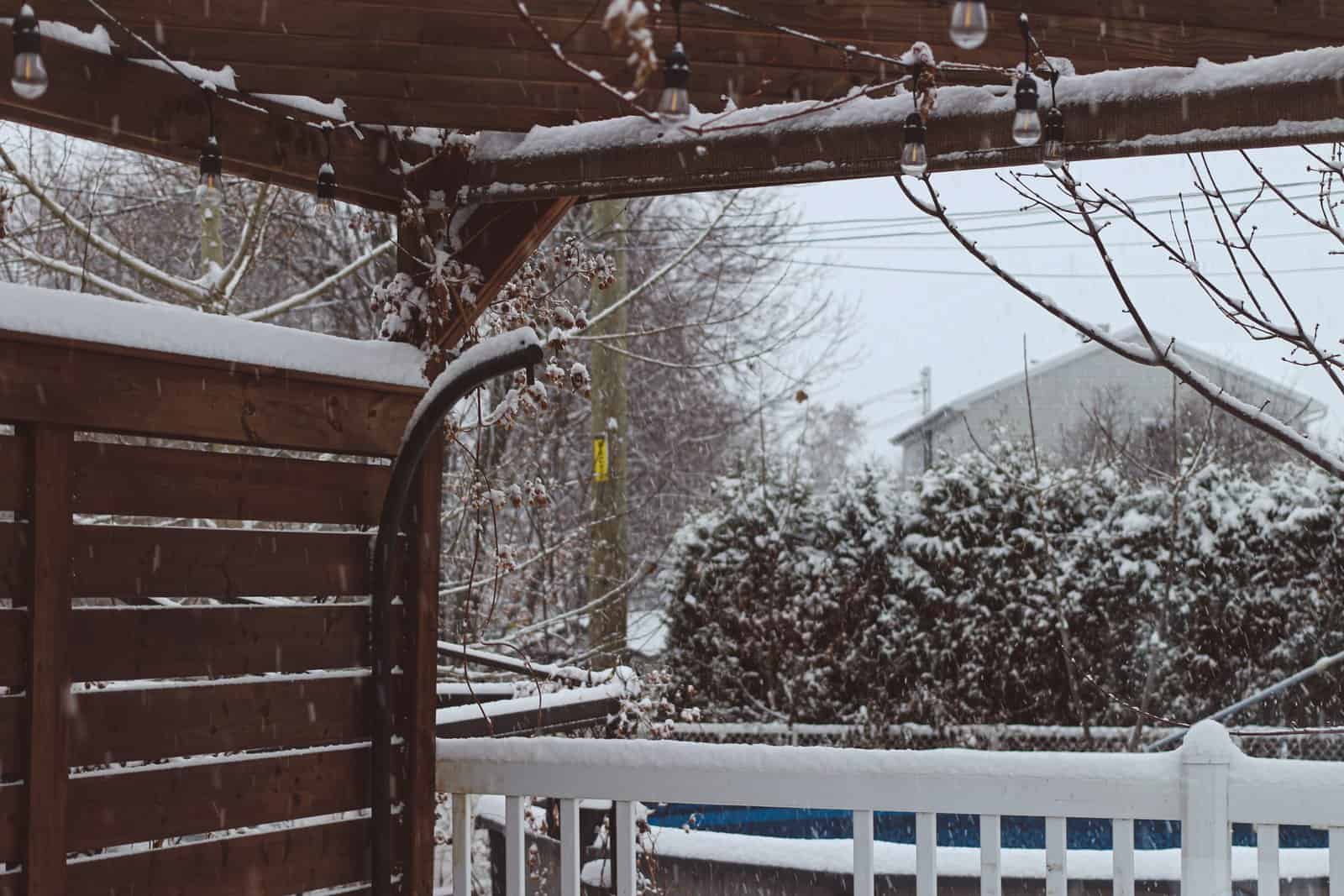
The pool is closed, the furniture is under cover, and the one piece of backyard water that gets better as the weather gets worse is the hot tub. The question we hear at the Reading Road counter every October is not whether to use it this winter. It is how to make the walk out to it, and the soak itself, something you look forward to when the wind is coming off the Ohio River at twenty degrees.
The answer is almost always some kind of enclosure. Not a sealed room, which causes problems of its own, but a roof, a wall or two, and a dry path. We have sold and serviced hot tubs in Cincinnati since 1966 and have seen every version of this, from a single lattice panel to a timber-frame gazebo with the spa sunk into the deck. Here is which enclosure fits which yard, where the permit line usually falls around here, the clearances that get forgotten, and the one mistake that ruins more spa enclosures than snow ever does.
The short version
- The best hot tub enclosure for a Cincinnati winter is a roofed structure with solid walls on the windward sides and at least one side open, so the wind is blocked and the steam still gets out.
- A privacy screen is the least expensive option and the one most yards should start with. A gazebo gives the most protection. A pergola sits in between and needs a roof panel to earn its keep in January.
- Build the enclosure around the spa, not before it. A hot tub arrives on its side on a cart and needs a clear path in, plus room for the cover to open and for the equipment panel to come off later.
- A fully closed room around a spa traps steam and sanitizer vapor. Without real ventilation you get mildew, corroded fixtures and rotting trim within a few seasons.
- A roofed structure on footings usually needs a permit in Greater Cincinnati; a freestanding screen usually does not. Your building department makes that call, so ask before you pour anything.
What is the best hot tub enclosure for a Cincinnati winter?
A roof with solid walls on the north and west sides and the remaining sides open or screened. That blocks the wind that does most of the damage here, keeps snow off the cover, and lets steam and sanitizer vapor clear instead of condensing on wood and metal. A gazebo built this way is the standard.
Cincinnati winters are not brutal by the numbers, but they are wet, windy and inconsistent: snow a few inches at a time, ice more often than people admit, and freeze and thaw swings all season. What makes a January soak miserable is rarely the air temperature. It is wind on wet skin during the thirty seconds between the cover and the water. Most of our winter wind comes out of the west and northwest, so an enclosure that is solid on those two sides and open to the south or east solves most of the problem with the least material. A cover under open sky collects snow that melts, refreezes and turns the cover heavy and waterlogged until it stops insulating and breaks at the hinge. If you can only afford one element, make it a roof over the spa and a screen on the windward side.
Gazebo, pergola, privacy screen or full room: which one fits your yard?
A privacy screen suits a small lot and a tight budget. A pergola suits a deck near a roofline that wants summer shade. A gazebo suits an open yard where the spa sits on its own pad. A full room suits almost nobody unless it is built like a sunroom, with ventilation, drainage and a vapor barrier.
Here is how the four options compare on what matters in this climate. None of this is a price list; every yard, slope and electrical run is different, so contact us about yours.
| Enclosure | Wind and snow protection | Ventilation | Permit likelihood | Watch out for |
|---|---|---|---|---|
| Privacy screen or panels | Blocks wind on one or two sides, no snow protection | Excellent, nothing to trap | Low for a freestanding screen; a tall fence is a different conversation | Anchoring. A lightweight screen in a February gust ends up on the cover |
| Pergola | Little on its own; good once you add a solid roof panel and curtains or louvers | Excellent | Varies; attached pergolas get reviewed more often than freestanding ones | Cover lifter clearance under the beams |
| Gazebo | Best of the group: roof plus walls where you want them | Good if at least one side stays open or louvered | High once it has footings and a roof | Spa delivery and future service access through the opening |
| Full enclosed room | Total | Poor unless you build in exhaust fans and a floor drain | High, treated as an addition | Moisture, sanitizer vapor and rot. This is a sunroom build, not a shed |
On the sloped older lots in Hyde Park, Clifton and Fort Thomas, the usual setup is a spa on a deck with the house as one wall and a louvered panel closing the second. On the flatter newer lots in Mason, West Chester and Union, where the spa sits out on a pad, the gazebo wins because nothing else breaks the wind. Kits with a spa cutout exist for both, and we can tell you which of our spas fits a given footprint before you commit to a structure.
Do you need a permit for a hot tub gazebo in Greater Cincinnati?
Usually yes for a roofed structure on footings, usually no for a freestanding privacy screen, and it depends for a pergola. Hamilton, Butler, Warren, Clermont and the Northern Kentucky counties each run their own permit desk, and cities add their own rules. Call the building department before you dig, and ask your HOA the same week.
Multi-county permitting is a fact of life here, so we will only say where the line usually falls. A structure with a roof and footings is treated as a building. A pergola with no solid roof is often treated as a landscape feature, until you attach it to the house or add a roof panel. A screen is rarely anyone’s concern, unless it is tall enough to count as a fence, and then fence rules and setbacks apply. The spa itself may have barrier rules in your jurisdiction, the same way a pool does. And the electrical work is its own permit: a hardwired spa has a disconnect that must stay within sight of the water and within a set distance of it. Code decides the number, your electrician knows it, and a gazebo wall should never end up between the two.
How much clearance does a hot tub need inside an enclosure?
Enough for four things: the cover to open all the way on its lifter, the equipment panel to come off the cabinet, a person to walk around at least two sides, and the spa itself to get in and out on a cart. Check the spa’s spec sheet and the lifter’s clearance before a single post is set.
This is why we say build the enclosure around the spa, not before it. A hot tub is delivered on its side on a cart, so the opening has to be wider than the spa is tall and the path from the driveway has to be clear of gates, steps and tight corners. We schedule delivery with you and go over the site and the electrical requirements before the spa arrives, and more than once that walk has ended with a gazebo wall coming back out. Then think about year five. Every spa has a removable cabinet panel with the pump, heater and control pack behind it, and framing tight to that side turns a pump swap into a carpentry job. Leave it reachable, leave room for the cover to swing up on its lifter without hitting a beam, and give yourself a dry place to stand on the way out: slip-resistant steps, a hook for the robe, a bench for the towels.
How do you keep a hot tub enclosure from trapping moisture?
Leave it open on at least one side, or build cross ventilation with louvers high on two opposite walls. A spa at one hundred degrees puts off steam every time the cover comes up, and that steam carries sanitizer vapor. Sealed in, it condenses on everything, corrodes hinges and light fixtures, and feeds mildew in the framing.
This is the mistake that ruins more spa enclosures than weather does. Someone builds a tidy room around the tub, closes the door against the cold, and eighteen months later the ceiling is spotted black and the cover lifter hinge has rusted through. Bromine and chlorine both leave the water as vapor, and in a room with no air exchange that vapor goes looking for metal and wood. The fix is simple at the design stage: keep a side open, use louvered panels where you want privacy, and if you insist on a closed room, build it like a sunroom with a wet-rated exhaust fan, a floor drain and a vapor barrier. Balanced water helps too. A spa running high on sanitizer or low on pH gives off more vapor and a sharper smell, which is exactly what you breathe in a tight space. Our hot tub water chemistry guide covers the four numbers, and we test water at the counter six days a week.
What makes a hot tub area comfortable at night in January?
Light you can see the steps by, a wind break on the exposed side, a dry path from the door, somewhere for towels that is not the snow, and a cover you can open with one hand. Together they are the difference between a tub you use and a tub you own.
Start with light. It is dark by half past five in December, and the top reason people skip a soak is that the path looks like a fall waiting to happen. Low-voltage path lights along the walk and a warm string light under the roof are enough; keep fixtures wet-rated and out of reach of the water, and run anything plugged in through a GFCI outlet. Then deal with the path. A shovel by the back door and a deck-safe ice melt handle it for most people. Give the towels a home under the roof or on hooks on the privacy wall, out of the wind. A fire table or patio heater near the steps turns the walk back into a stroll. If you are building the space from scratch, our outdoor living showroom plans seating, lighting and shade around a spa in one visit, and the aluminum patio furniture on our floor can stay out next to a tub all winter.
Should you run your hot tub all winter or shut it down?
Run it. A modern spa with a good cover is designed to sit at temperature through an Ohio winter, its freeze protection keeps water moving through the plumbing on the coldest nights, and winter is when you will want it most. Draining and winterizing is for a spa you truly will not touch until spring.
Every spa on our floor is built to run year round; the enclosure is what makes that pleasant rather than merely possible. Three habits keep it that way. Keep the temperature set and leave it there, because letting the water go cold between soaks costs more to recover than it saves. Keep the sanitizer feeding and test weekly, because warm water does not take a holiday. And look after the cover, the single biggest factor in what the spa costs to run: brush snow off before it melts into the foam, condition the vinyl with a spa cover conditioner a couple of times a season, and replace a cover that has gone heavy, because a waterlogged cover insulates about as well as a wet blanket. If the electric bill is the worry, we covered what actually drives hot tub running costs in an Ohio winter.
A winter checklist from the Reading Road counter
What we run through with every spa owner heading into a first Cincinnati winter, enclosure or not.
- Confirm freeze protection is on and the thermostat is set where you want it. Then leave it alone.
- Check the cover for cracks, a heavy feel or a sour smell. Any of the three means it is holding water.
- Make sure the cover lifter opens fully with the enclosure in place, and that the equipment panel is reachable.
- Clean or swap the filter before the cold sets in. A clogged filter makes the heater work harder on the coldest nights.
- Walk the path at night. If you would not send a guest out there in socks, add a light or a handrail.
- Keep the spa chemicals and test strips inside the house. Cold wrecks test strips and clumps granular shock.
Come sit in one before you build around it
The right enclosure depends on the spa, the yard and how you plan to use it, and the easiest way to get all three right is to start with the spa. The Wellis and Dream Maker models on our floor are filled and heated so you can wet test before you buy, and the people who deliver it are the same people who will tell you honestly whether that gazebo opening is wide enough. We are at 10731 Reading Road, open Monday through Saturday, serving backyards from West Chester to Anderson Township since 1966. Start with our hot tub buying guide if you are new to this, then visit the hot tub showroom or send us a note and we will have one heated for you.
Frequently asked questions
A rigid foam cover with a tapered core, a sealed vapor barrier around the foam, a heavy marine-grade vinyl skin and locking straps. Thicker foam at the center sheds snow and water; the vapor barrier is what keeps the foam from getting heavy. Fit matters as much as spec: a cover that does not seal to the acrylic lip leaks heat all night.
Yes, and it is one of the most common setups on Cincinnati decks. On its own a pergola gives shade and a frame to hang curtains or string lights from, but very little weather protection. Add a solid or polycarbonate roof panel over the spa and louvered or curtain panels on the windward side, and check that the cover lifter clears the beams before you set the posts.
A freestanding privacy screen or two anchored on the windward side of the spa, plus a good cover. That blocks most of the wind for the least material and almost never needs a permit. Skip the soft pop-up tents and inflatable domes; they trap moisture, catch the wind, and do not survive an Ohio ice storm. For a quote on anything built, talk to a deck builder or contact us.
No. A pool is closed because it cannot be kept warm economically and its plumbing will freeze. A hot tub is insulated, covered, and built to hold temperature through the winter, with freeze protection that circulates water on the coldest nights. The only reason to drain and winterize a spa is if nobody will use it for months, and even then it must be blown out properly so no water is left in the lines.
That is a setback question and it varies by city and county across Greater Cincinnati and Northern Kentucky, so your building department has the real answer. Two things apply almost everywhere: a roofed structure attached to the house is reviewed as an addition, and the spa’s electrical disconnect has to stay within sight of the water and within the distance code sets. Plan the enclosure around both before you build.