



We Speak Pool and Spa.
We Got You.
Fire Pit vs Fireplace vs Chiminea: Extending Your Ohio Season

Somewhere around the week the pool gets closed, the conversation at our Reading Road counter changes. People stop asking about chlorine and start asking how to keep using the backyard once the evenings turn cold. It usually comes down to one question: should I put in a fire pit, build an outdoor fireplace, or pick up a chiminea?
We have been helping Greater Cincinnati and Northern Kentucky families set up their backyards since 1966. None of these options is the best choice across the board. Each one wins in a specific kind of yard and household, and each one fails in a predictable way when it goes into the wrong spot. This is how we walk customers through the decision.
The short version
- A fire pit gives you a 360-degree gathering spot, but most of its heat rises straight up and the smoke follows whoever is sitting downwind.
- An outdoor fireplace throws heat forward and sends smoke up a chimney, but it is a construction project that needs a real footing below our frost line.
- A chiminea is the small patio answer: compact, directional heat and a chimney, though a clay one can crack if it sits out wet through a freeze.
- A gas fire table trades some heat for no smoke, no sparks on your cushions, and an off switch, which is why it fits most patio furniture layouts so easily.
- Before you buy anything, call your city or township fire department about distance rules, and look up at the roofline, gutters and tree limbs above the spot you have in mind.
What is the real difference between a fire pit, an outdoor fireplace and a chiminea?
A fire pit is an open fire you sit all the way around. An outdoor fireplace is a walled firebox with a chimney, facing one direction. A chiminea is a small freestanding chimney stove, usually clay or cast metal, with a front opening and a flue. They differ in heat direction, smoke control, installation and how much yard they take over.
The shape of each one decides almost everything else about it. A fire pit is a ring of stone, block or steel with the fire exposed on top. Everyone sits in a circle, which is exactly why people love them. It is the campfire experience, and nothing else on this list quite matches it for a group of eight on a Friday night.
An outdoor fireplace is closer to architecture than to furniture. It has a back wall, a firebox, a hearth and a chimney, and it is built in place from masonry or a manufactured masonry kit. It anchors one side of a patio the way an indoor fireplace anchors a living room. Once it is built, that is where your seating faces for the next thirty years.
A chiminea sits somewhere in between. Think of it as a small fireplace you can carry, or at least move with two people and a hand truck. The fire burns in a rounded belly, the opening faces one direction, and a narrow chimney carries the smoke up and out. Traditional ones are clay. Most of what people buy today is cast iron, cast aluminum or steel.
Which one actually keeps you warm on a 45-degree October night?
A fireplace, if you sit in front of it. Its back wall reflects radiant heat toward the seating. A chiminea does the same on a smaller scale. A fire pit warms your face and leaves your back cold, because most of its heat escapes straight up. Gas fire tables give the least heat and work best at arm’s reach.
Heat from an open fire reaches you mostly as radiant energy, the way the sun warms your face on a cold, clear day, and it travels in straight lines. A fire pit radiates in every direction, including straight up, so a big share of what you burn never touches anybody. Hence the toasty front, the chilly back, and chairs that creep closer as the evening goes on.
A fireplace fixes that with its back and side walls, which catch heat that would otherwise escape and send it toward the seating. On a still October evening in the mid 40s, a well-built outdoor fireplace with a good hardwood fire keeps a small group comfortable in light jackets. Only the people facing it get the benefit.
A chiminea works on the same principle at about a third of the scale. The belly and the opening push the heat forward, so two or three people in front of it stay warm while anyone off to the side does not. Because the firebox is small, you feed it small pieces of wood more often.
Gas fire tables are honest about what they are. They give you real flame and real warmth on your hands and knees, but they are not trying to heat a patio. Expect ambience with a comfortable warm zone around the table, not bonfire heat.
| Option | Heat | Smoke | Installation | Best fit |
|---|---|---|---|---|
| Wood fire pit | Strong but all around, much of it lost upward | Heavy, and it shifts with the wind | Weekend project or a pro build on a gravel base | Larger yards and groups who want the campfire feel |
| Outdoor fireplace | Strongest usable heat, directed at the seating | Carried up the chimney | A true construction project with a footing below the frost line | Patios designed as an outdoor room |
| Chiminea | Good directional heat for two or three people | Mostly carried up the flue | Set it on a non-combustible surface | Small patios, renters, trying fire before building |
| Gas fire table | Modest, best at arm’s reach | None | Hidden propane tank, or a natural gas line run by a licensed plumber | Patio furniture groupings, decks where the manufacturer allows it, smoke-sensitive neighbors |
Where does the smoke go with each option?
With a fire pit, the smoke goes wherever the breeze sends it, which usually means into somebody’s face and through your neighbor’s open window. Fireplaces and chimineas lift it up a chimney, so the seating area stays much clearer. Gas produces no wood smoke at all. If you have close neighbors or anyone in the house with asthma, weight this heavily.
Smoke is the usual complaint from people who already own a wood fire pit. In older neighborhoods like Oakley, Westwood or Fort Thomas, where houses sit close together, it drifts straight over the fence line on a calm night. Open fires just behave that way.
A chimney changes the physics. Hot gases rise through the flue, which pulls fresh air in through the opening and sends the smoke up above head height. A fireplace does this best because its chimney is tall. A chiminea does a decent job with its short stack, especially once the clay or metal is warm and the draft gets going.
Whatever you burn, the wood matters as much as the design. Wet or green wood smolders and smokes no matter what it is burning in. Buy seasoned hardwood, split and dried for at least a season, and buy it locally rather than hauling it in from out of state, which is how tree pests get moved around. Never burn painted scrap, pallets or pressure-treated lumber in any of these.
How do Ohio fire rules and distances affect your choice?
Ohio’s open burning rules allow a recreational fire of clean, dry firewood but not burning leaves or trash inside most municipalities. On top of that, cities and townships set their own distance and permit rules, and manufactured units carry clearances from the maker. Call your local fire department before you choose a spot, not after you have poured a base.
Ohio draws a clear line between a recreational fire and open burning. A small fire of clean, seasoned firewood for warmth or cooking is treated very differently from burning a pile of leaves, which inside most of our cities and villages you cannot do.
Where it varies is distance and permits. The model fire code most Ohio communities build on treats an open wood fire more strictly than a manufactured appliance used according to its instructions, and many local rules put an open wood fire a good 25 feet from the house and anything combustible. Some cities want a permit for a built-in pit. Some townships in Butler, Warren and Clermont counties handle it differently from the City of Cincinnati, and Northern Kentucky has its own set of local rules. The number that matters is the one your own fire department gives you, and a two-minute phone call settles it.
Distance also protects things the code never mentions. Vinyl siding can warp from a fire pit that sits too close to the house for a single season. Look up, too. Gutters, a pergola, an umbrella and low maple limbs are all fuel. If you are putting a gas fire table under a covered patio, the manufacturer’s overhead clearance is a hard requirement, not a suggestion.
How does each one hold up to Cincinnati freeze and thaw winters?
Clay chimineas are the most fragile, because water soaks into the clay and cracks it when it freezes. Steel fire pit rings rust thin over the years, and block pits heave on clay soil without a compacted gravel base. Well-built masonry fireplaces and covered gas fire tables handle our freeze and thaw winters best.
Our winters do not stay frozen. We freeze, thaw, rain and freeze again from December through March, and every cycle works water into anything porous and then expands it.
Clay chimineas take the worst of that. Unglazed clay absorbs water like a flowerpot, and a chiminea that sits out full of rainwater through a January cold snap can split right up the belly. If you love the look of clay, keep a fitted cover on it, empty the ash so it does not hold moisture, and move it into a garage or shed for the deepest part of winter. Cast iron and cast aluminum chimineas shrug off freezing, though iron will need its rust touched up now and then.
Fire pits built from retaining wall block or pavers have a different enemy, which is the ground underneath them. Much of Greater Cincinnati sits on clay soil that swells when wet and heaves when frozen. A pit set straight on dirt, or on a thin layer of sand, will tilt and gap within a couple of winters. Dig out, lay a compacted gravel base, and use a steel ring or fire brick liner so the fire never sits directly against ordinary concrete block, which can crack and flake from the heat.
An outdoor fireplace needs a proper concrete footing that goes below the frost line, the same way a house foundation does. Skip that and the whole structure moves, the mortar joints open up, and water gets in to finish the job. Built right, a masonry fireplace is the most durable option on this list.
Gas fire tables need less than people expect. Cover the table when it is not in use, keep water from pooling in the burner pan, and let wet lava rock or fire glass dry out before you light it, because trapped moisture can make rock pop when it heats. Disconnect the propane tank for the months you are not using it.
What does each option ask of your yard and your time?
A chiminea asks almost nothing: set it on stone or pavers and light it. A fire pit is a weekend project or a short professional install. A fireplace means design, excavation, masonry and usually a permit. A gas fire table runs on a propane tank hidden in its base, or a natural gas line run by a licensed plumber.
Be realistic about the whole commitment, not just the evening you picture. A chiminea goes on a patio, a gravel pad or pavers, never directly on a wood or composite deck, and it is ready the day you bring it home. It is also the one option you can take with you if you move, which makes it a smart first step for anyone not sure how much they will actually use a fire.
A fire pit takes some digging, so call 811 before you break ground. Ohio811 covers our side of the river and Kentucky 811 covers Boone, Kenton and Campbell counties, and the locate service is free. A fireplace takes more planning: where the chimney sits relative to the house, how the patio drains around it, and how your seating faces it.
For a gas table, the easy route is a standard propane tank hidden inside the base, so there is nothing to install. If you would rather never swap a tank, a natural gas line is the upgrade, and that is work for a licensed plumber who pulls the permit.
Where does a gas fire table fit into all of this?
A gas fire table is often the best fit for a patio furniture grouping, because it works inside the layout instead of forcing the layout around it. You get real flame at the flip of a switch, no smoke, no sparks on cushions, and it shuts off completely when you go inside. The trade is less heat than wood.
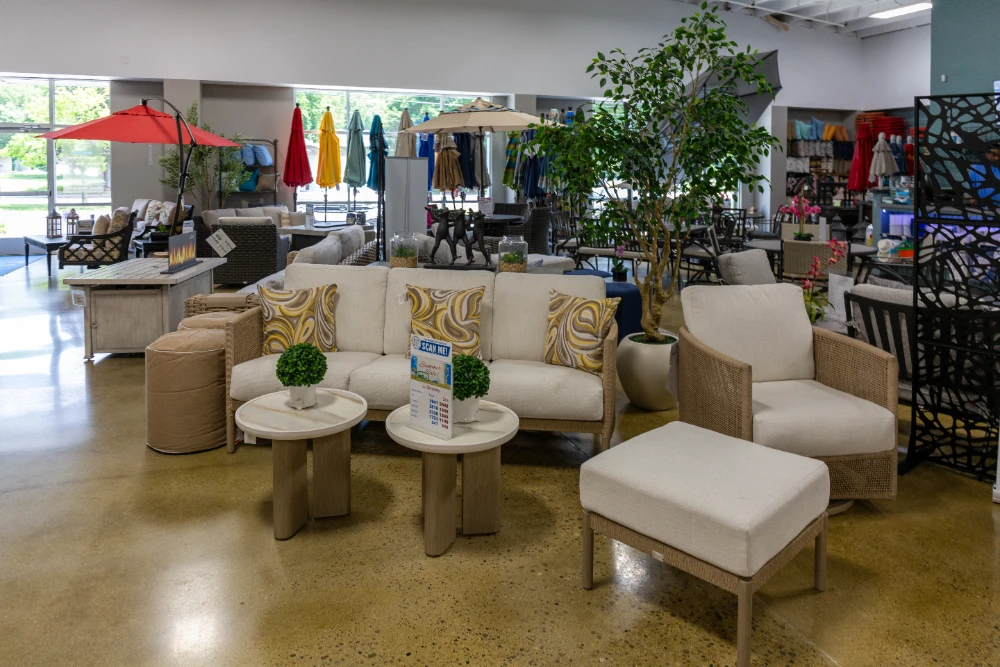
Fire tables sit right alongside the conversation sets in our patio furniture lineup, and the reasons people choose them are practical rather than trendy. A wood fire throws sparks and embers, and one ember is enough to burn a small hole through a good outdoor cushion. Parents like that there is no glowing bed of coals sitting in the yard after everybody goes in. People with close neighbors like that nothing drifts over the fence.
A fire table also does double duty. At table height it is a place to set drinks and plates, and with the lid on it is simply a table. Paired with a deep seating group, it turns a patio into a room people actually use in October and November. Take a look at the outdoor furnishings we carry to get a sense of how a set and a fire feature work together.
Where a fire table is the wrong call is when heat is the whole point. If you want to sit out on a 35-degree night in a sweatshirt, a wood burning fireplace or a big fire pit is going to serve you better, and we will tell you that.
So which should you choose for your backyard?
For a small patio or a townhouse lot, choose a chiminea or a gas fire table. For a larger, flat yard and a group that wants a campfire, choose a wood fire pit. For a patio designed as an outdoor room, build a fireplace. If smoke would bother your neighbors or anyone at home, go gas.
Picture how you will actually use it on an ordinary Tuesday, not just on the one big party. A couple on a small patio in Hyde Park or a condo courtyard in Covington will get far more evenings out of a chiminea or a fire table than out of a pit they have to tend. A family with a big, flat yard in Mason or West Chester, kids who want to roast marshmallows, and enough distance from the house has the perfect spot for a wood fire pit.
The fireplace is for people who already treat their patio as a second living room. It pairs well with a covered area, a grill station and permanent seating designed as one space.
Plenty of our customers combine options over time. They start with a chiminea to find out how often they really go out on a cold night, then commit to something permanent once they know. Others pair a fire table with a hot tub so the backyard works all winter. If that is where your head is, our guide to what really drives hot tub running costs in an Ohio winter and our hot tub buying guide are good next reads.
Keep the backyard open after the pool closes
Closing the pool does not have to close the backyard. Once your pool closing is on the calendar, fall is the ideal time to plan the fire feature and seating you will use through November. Browse our outdoor living selection, see the grills that round out an outdoor kitchen, or check out the hot tubs in Cincinnati customers pair with a fire table for winter. Our pool and spa service team handles the water side, and our showroom staff will help you figure out the fire side.
Stop by the Reading Road store, tell us about your yard, and we will help you pick the option that fits, even when the honest answer is a chiminea. For pricing on anything we carry, contact us for a quote.
Frequently Asked Questions
Not a wood burning one sitting directly on the boards. Embers and radiant heat can scorch wood decking and soften or melt composite. If you want fire on a deck, a gas fire table whose manufacturer specifically approves deck use is the safer route, installed with the clearances in its manual. A wood chiminea belongs on stone, pavers or a gravel pad.
For most September and October evenings, yes, as long as you sit close. A gas fire table warms hands, knees and faces within a few feet, which is plenty with a jacket on a night in the 50s. Once nights drop toward freezing it becomes more about ambience than heat, and a wood fireplace or a large wood fire pit will keep a group warmer.
It depends on where you live. Ohio allows small recreational fires of clean firewood, but each city, village and township sets its own rules on distance from structures and on permits for built-in pits, and Northern Kentucky communities have their own rules as well. A new natural gas line needs a licensed plumber and a permit. Call your local fire department before you build.
It can survive outside if it stays dry, which is harder than it sounds in our climate. Unglazed clay soaks up rain, and water that freezes inside the clay can crack it. Empty the ash, keep a fitted cover on it, and if you have the room, move it into a garage or shed for the coldest months. Cast iron and cast aluminum chimineas handle freezing weather without that risk.
Seasoned hardwood that has been split and dried for at least a season, such as oak, hickory or maple. It lights more easily, burns hotter and makes far less smoke than green wood. Buy firewood locally instead of bringing it in from out of state, and never burn pallets, painted scrap or pressure-treated lumber, which release fumes you do not want to breathe.