



We Speak Pool and Spa.
We Got You.
Best Patio Furniture Material for Ohio Weather
Patio furniture in Greater Cincinnati has a harder job than the catalog photos suggest. The same chair has to sit through a July afternoon in the low 90s with the humidity to match, a November rain that never quite dries, and a January that drops into single digits and then thaws by Thursday. A set that would last twenty years in Phoenix can look tired here in three, and the difference is almost always the material, not the name on the tag.
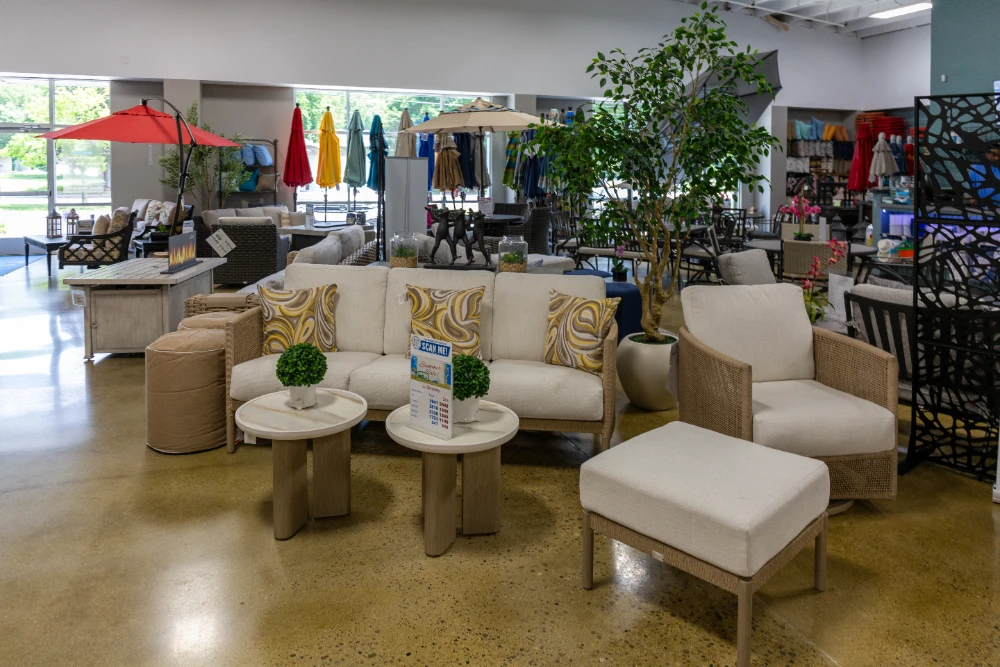
We sell outdoor furniture out of the same Reading Road showroom that has sold pools since 1966, and what sits on our floor is there because it holds up to Ohio winters. This is the material guide we walk a customer through in the store: how aluminum, resin wicker, poly, steel and teak each handle a Cincinnati year, which one we chose for our own floor, and when we will tell you a different material is the better buy.
The short version
- Powder-coated aluminum is the best all-around patio furniture material for Ohio weather. It cannot rust, it shrugs off freeze-thaw, and it is light enough to move and store. It is what we put on our own showroom floor.
- Resin wicker is a good choice here only when it is woven over an aluminum frame. Natural wicker and rattan absorb Cincinnati humidity and mildew.
- Poly (HDPE) furniture is the heaviest and most freeze-proof option and the right call for an open, windy lot. We do not stock it, and we will say so when it is what your yard needs.
- Steel and wrought iron rust at the welds once the coating chips, and a wet Ohio winter finds the chip. Teak survives but turns gray and needs yearly care.
- The cushion fabric matters as much as the frame. Look for solution-dyed acrylic, and bring the cushions in for the winter no matter what the frame is made of.
What is the best patio furniture material for Ohio weather?
Powder-coated aluminum. It does not rust, it does not split when trapped water freezes, it stays light enough to carry under cover, and a baked-on powder coat holds its color through our summer sun. For most Greater Cincinnati patios it is the material that still looks right in year ten. Cast aluminum and poly are the two runners-up.
Ohio runs four tests on outdoor furniture, and no material aces all four. Water plus freezing: anything that holds a few drops inside a tube, a joint or a screw hole gets split open over a winter. Humidity plus metal, which is where rust and mildew come from. Sun, which fades cheap fabric and chalks cheap paint between May and September. And wind, which matters more on an open lot in Mason or West Chester than on a treed street in Hyde Park, and is the one test where light furniture loses.
Aluminum passes the first three cleanly and only gives up ground on the fourth. Cast aluminum and poly pass the wind test too, but cost you the ability to lift a chair with one hand. Everything else fails at least one test outright. The table below is the short form.
| Material | Freeze-thaw | Humidity and rust | Sun and fade | Weight and wind | Yearly care |
|---|---|---|---|---|---|
| Powder-coated aluminum (extruded) | Excellent, nothing to split | Cannot rust | Very good with a quality powder coat | Light, can blow over on an exposed lot | Rinse, check glides, store cushions |
| Cast aluminum | Excellent | Cannot rust | Very good | Heavy, stays put | Rinse, touch up chips |
| Resin wicker on an aluminum frame | Very good if the weave is HDPE | Weave and frame both shrug it off | Good; cheap PVC weave fades and cracks | Medium | Rinse the weave, store cushions |
| Poly lumber (HDPE) | Excellent, solid all the way through | Nothing to rust or rot | Very good, color runs through the board | Heaviest option, ideal in wind | Soap and water |
| Steel or wrought iron | Poor; hollow steel holds water and splits | Rusts at any chip or weld | Fair | Heavy | Repaint, treat rust spots |
| Teak and dense hardwoods | Good | Resists rot, can mildew in shade | Turns silver gray within a year | Medium to heavy | Clean and oil every spring |
Why does Cincinnati weather punish patio furniture more than you expect?
Because it swings. A Cincinnati winter crosses the freezing line dozens of times instead of freezing once and staying frozen, so water inside a frame, a joint or a cushion expands and relaxes over and over. Add a humid summer, strong sun from May through September and steady tree debris, and every weakness gets found within a few seasons.
The freeze-thaw cycle is the one most people underestimate. A tubular steel chair leg takes on rain through its drain hole or screw holes, the water freezes on a Tuesday night, thaws on Thursday, and does it again dozens more times before March. By spring the weld at the bottom of the leg has a hairline crack and the rust starts from the inside, where no paint can reach it. Solid materials and materials that cannot rust do not have that failure.
Then there is what falls out of the trees. Maple helicopters in May, cottonwood fluff in June, and in October the oak and walnut leaves that leave brown tannin stains on a light cushion if they sit wet for a weekend. A material that rinses clean with a hose is worth more here than one that needs a brush. On the sloped older lots across Anderson Township and Fort Thomas, a terrace also catches wind a flat yard never feels, which is why weight is in the table at all.
Why is aluminum what we put on our own showroom floor?
Aluminum cannot rust, so a chipped coat is a cosmetic problem instead of a structural one, and a welded aluminum frame does not hold water the way tubular steel can. One person can carry a chair to the garage in November. The Life Outside Clark collection on our floor is powder-coated aluminum for exactly those reasons.
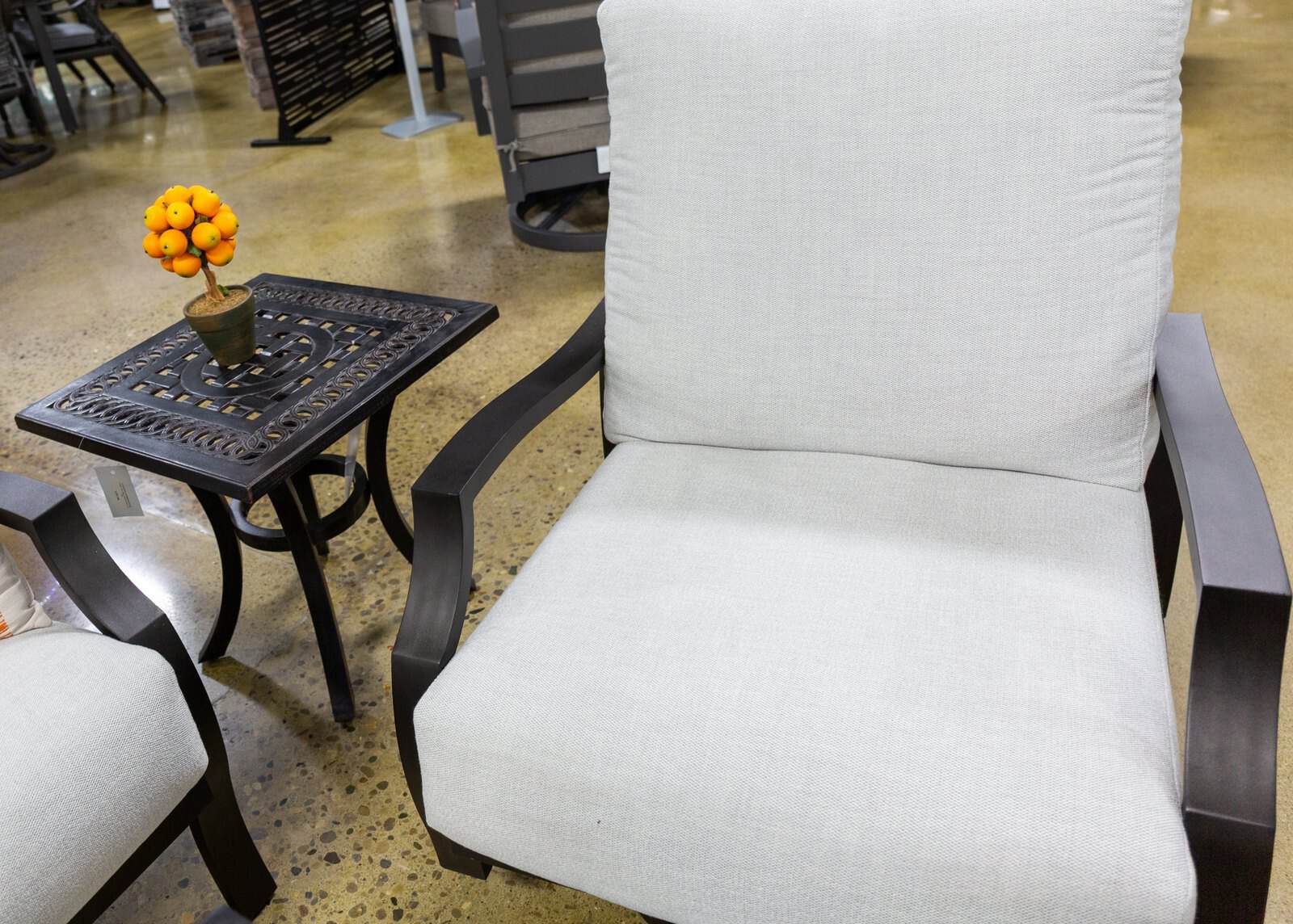
There are two kinds of aluminum furniture and you can feel the difference the moment you lift them. Extruded aluminum is hollow profile welded into a frame, and it is what most dining sets, deep seating and sling chairs are built from. Cast aluminum is poured solid into a mold, which is how you get the ornate tabletop in the photo above and a piece heavy enough to ignore a thunderstorm. Both get a powder coat, a dry pigment baked onto the metal, which is a tougher skin than sprayed paint and the reason a good frame still looks right after years of Ohio sun.
When you look at an aluminum frame in the store, check three things. The welds should be smooth and continuous, not a row of spot tacks. The frame should feel rigid with no flex when you push on the arm. And the feet should have nylon glides so the frame is not sitting in a puddle all spring. You can do all three on our patio furniture floor in Cincinnati, and the Clark aluminum pieces are listed online if you want to study the lineup first. The one honest drawback is weight: on a hilltop lot with nothing between you and the wind, an extruded aluminum chair can travel. Add cast pieces, clip the cushions and plan on covers.
Is resin wicker patio furniture a good choice in a humid climate?
Yes, if it is all-weather resin woven over an aluminum frame. The weave itself shrugs off rain and humidity. Natural wicker, rattan and seagrass do not; they absorb moisture, mildew in a Cincinnati August and go brittle after a winter or two. Check the frame under the weave before you check the color.
Wicker is a weave, not a material, and that is the whole trick to buying it. Good outdoor wicker is HDPE resin extruded into strands and woven over a frame. It does not absorb water, it does not care about humidity, and a quality strand carries UV inhibitors so the color lasts. Bargain wicker is PVC, which looks the same on the floor and then fades, gets sticky in July and cracks in the first real cold snap.
The hidden failure is the frame. Plenty of inexpensive wicker is woven over tubular steel, and when that steel rusts the stain bleeds through the weave and there is no fixing it. Flip the piece, find bare frame, and if a magnet sticks, walk on. The wicker sofa in our backyard design guide is resin over aluminum, the only version we would put next to a pool.
How does poly (HDPE) furniture hold up in Ohio, and when is it the better buy?
Poly lumber is about as freeze-proof as outdoor furniture gets: solid high-density polyethylene with no coating to chip, no fibers to absorb water and enough weight that a storm will not move it. It is the better buy for an exposed, windy lot. We do not carry it, and we will tell you when it fits your yard.
Poly lumber is recycled HDPE formed into boards with the color run all the way through, so a scratch shows the same color underneath. Nothing about an Ohio winter bothers it. It will sit on an open deck through ice, snow and a whole winter of freeze-thaw swings and look the same in April, which is why you see it on lake docks and on wide-open lots off I-71.
The trade-offs are real. A poly dining chair is heavy enough that rearranging the patio for a party is a two-person job, dark colors get hot in direct July sun, and the styles run to Adirondack and farmhouse rather than deep seating. Our floor is aluminum, so when a customer describes a ridge-top lot in Warren County with no windbreak, we say plainly that poly or cast aluminum will serve them better than a light extruded set, and we would rather lose that sale than sell the wrong chair.
What about steel, wrought iron and teak?
Steel and wrought iron are strong and heavy but rust the moment the coating chips, and a wet Ohio winter finds every chip. Teak and other dense hardwoods survive outdoors here but turn silver gray and need cleaning and oiling every year. Both can work on a covered porch. Neither is our first choice for an open Cincinnati patio.
Tubular steel is the material behind most of the furniture that gets dragged to the curb after three summers: cheap, strong the day you buy it, and hollow, so it holds water inside the tube where the freeze does its work. Solid wrought iron is nearly indestructible if you will wire brush and repaint the rust spots every couple of years, and it belongs on a covered porch in Clifton more than on an open deck. Teak goes silver and keeps working, or stays honey colored if you clean and oil it every spring.
Can you leave patio furniture outside all winter in Cincinnati?
Aluminum and poly frames can stay out, and cast aluminum and poly do not even need tying down. Cushions should never stay out; bring them in dry, because a cushion that freezes wet comes back in April with mildew in the core. Umbrellas come down and get stored closed, and a cover only helps if it breathes.
Frames are the easy part; the spring mistakes are about everything else. An umbrella left up catches a wet March snow and bends the ribs. A tight plastic tarp over a sofa traps condensation against the cushions and grows mildew faster than leaving them bare would have. Furniture parked on the lawn instead of the patio sinks into our clay as it heaves and settles over the winter.
The routine that works: cushions and pillows indoors and dry, umbrella closed and stored, frames rinsed, stacked where you can and set on hard surface, and a vented cover cut for the set rather than a tarp. Ask about a cover sized for your set when you buy it. Our older guide to preparing outdoor furniture for bad weather covers the storage steps, and if the patio sits beside one of the pools we build as Cincinnati pool builders since 1966, the furniture comes in the same week the pool gets closed.
How do you judge quality when you are standing in the showroom?
Lift the chair, look at the welds, read the fabric tag and ask what the warranty covers. A quality aluminum frame feels rigid with no flex at the joints, the welds are smooth and continuous, the fabric is solution-dyed acrylic and the cushion core drains. Anything that wobbles on a level showroom floor will wobble worse on a patio.
The fabric tag is the part most people skip. Solution-dyed acrylic has the color locked into the fiber before it is woven, so it fades far slower than printed polyester and can take a mild bleach solution when the oak leaves win. The cushion core should drain and dry; press on it and watch how fast it springs back. Then ask what the warranty covers separately, frame, finish and fabric, because a long frame warranty with a short fabric warranty tells you where the maker expects the piece to fail. None of this works from a photo, which is the whole argument for a showroom.
Come sit on it before you decide
The best patio furniture material for Ohio weather is the one that is still comfortable and still square in year ten, and for most yards here that is powder-coated aluminum. If your lot argues for something heavier, we will say so. Fall and winter are the quiet months at 10731 Reading Road in Evendale, open Monday through Saturday, which makes it the best time to sit on every set in our outdoor living showroom, see the hot tubs and grills that share the patio, look through the gallery, and plan the space before spring. Contact us with a photo of your patio and we will tell you which material fits it.
Frequently asked questions
Cast aluminum and solid poly (HDPE) last the longest outdoors in Ohio because neither can rust, rot or split in a freeze. Powder-coated extruded aluminum is a close third and far lighter to handle. In every case the frame outlasts the cushions, so the fabric you choose decides how long the set looks new.
No. Aluminum forms its own thin oxide layer instead of rusting, so a chip in the powder coat shows bare gray metal but does not spread or weaken the frame the way rust does on steel. Wipe the spot clean and touch it up if the look bothers you. The screws and hardware are the only parts that can rust, so check that they are stainless.
Most good outdoor wicker is aluminum underneath, so the real choice is the look and the cushion depth, not the durability. Resin wicker over an aluminum frame handles Cincinnati humidity and freeze-thaw as well as a plain aluminum set. Avoid wicker woven over tubular steel, which rusts through the weave, and avoid natural rattan outdoors entirely.
Aluminum, cast aluminum and poly frames can stay outside through a Cincinnati winter, and the heavy ones do not need to be tied down. Cushions, pillows, umbrellas, natural wicker and untreated wood should come in. Set frames on a hard surface rather than the lawn, stack what you can, and use a vented cover instead of a plastic tarp.
Yes. Dark poly lumber in direct July sun gets hot enough to notice when you sit in shorts, and the same is true of bare aluminum arms. Light colors, a shade umbrella or a cushion solve it. Poly also holds the cold longer in spring and fall, which is one more reason a cushion belongs on it.